U.S. Three-Sheet Poster
Hotel, a drama directed by Richard Quine and based on a popular novel by Canadian writer Arthur Hailey, is the story of a battle for the historic St. Gregory Hotel in New Orleans. [Note: The book was popular enough that it also inspired a U.S. television series that ran for five season, starting in 1983. The series was set in San Francisco.] Melvyn Douglas plays Warren Trent, the hotel owner, and Rod Tayler is Peter McDermott, the hotel manager. The hotel has been struggling financially and is ripe for a takeover, unless it can find new financing. Trent is concerned about what will become of his employees and maintaining the historical integrity of the hotel operation. He wants it to maintain its charm and elegance, not become a modern, heartless, money-maker.
Kevin McCarthy is Curtis O'Keefe, a prominent hotel owner, who arrives intent on purchasing the hotel. He has a vendetta against Trent, because Trent rudely turned him down for a job when O'Keefe was just a young, struggling kid in the hotel business world. When O'Keefe arrives at the St. Gregory, he has several people in tow, including his French girlfriend, Jeanne Rochefort, played by Catherine. O'Keefe is competing against a real estate group that wants to buy the hotel in order to tear it down and build an office building. Also, on the side, Trent and McDermott are trying to negotiate a financing deal with a union.
During the negotiations and maneuvering (which includes an affair between Peter and Jeanne, who were immediately attracted to one another), two main side stories are being played out. One involves Karl Malden as a thief working the hotel. The other involves Michael Rennie, as a Duke who killed a child in a hit-and-run car accident, and Merle Oberon as his wife, who is trying to cover up the incident to protect her husband. Richard Conte is a hotel detective who becomes embroiled in the effort to cover up the Duke's crime.
Hotel is a very good, professional, well-made film, which clearly had a significant budget (reportedly $4,500,000) and is a must-see for Catherine fans. In addition to the impressive cast of veteran actors, the hotel set built on the Warner Bros. lot is quite impressive, and the jazzy soundtrack is nicely done. There is very little not to like about this film. My only real complaint (and a minor one, at that) is why Quine would have felt it necessary or desirable to use the soft-focus technique on close-ups for Catherine. That kind of shot would make sense, and was often used for an older actress, like Merle Oberon, but it was not the best idea for a 21-year-old beauty like Catherine.
Although it is fairly lengthy at 124 minutes, Hotel moves along briskly and never slows down, even with only one action sequence near the end (where an elevator in the hotel is faulty and crashes to ground level). To the extent that the film was not the big hit that Warner Bros. had hoped for, what, then, was the problem? My guess is that this film was about three years too late. In my opinion, it holds up well today, but in 1967 the American movie scene was undergoing a significant transformation. Although it has a couple of racy-for-the-times scenes involving strippers and prostitutes, Hotel seems more in tune with an older style of big-studio movie-making than it does with the more cutting edge films that were being produced at that time. For that reason, I suspect that it did not attract the interest of 1967's younger moviegoers. I suppose that the St. Gregory making way for a new office building at the end of the film is symbolic of Hotel making way for a new wave of Hollywood film-making. With all of that said, I would be shocked to learn that the studio didn't make money on this film worldwide.
As for our favorite actress, Catherine, how did she fare amongst this group of top-notch veteran actors? In my opinion, she did a good job, even though I felt her performance didn't show some of the personality that we had previously seen from her on-screen. She certainly looked beautiful. With that said, however, I also thought that she seemed a little physically stiff in her performance. She just never seemed to show, or have the opportunity to show, all of the on-screen qualities that had made her into an international star, and I think there is a clear reason for that. Even though Catherine was a veteran actor by 1966, Hotel is the first film that she had ever made with direct sound. She was accustomed to shooting film and then dubbing her lines later. To complicate matters even more, imagine how difficult it must have been for Catherine to learn her lines in English, and then deliver them for the first time in a way that was acceptable for direct sound while the cameras were rolling. Even though she may have mouthed her lines in English for The Empty Canvas in 1963, the actual sound was dubbed later in a studio. Clearly, it would be easier for a person to read a foreign language for later dubbing than it would be to appropriately speak the foreign language while the cameras are rolling. It was nice, however, hearing Catherine's heavily-accented English in direct sound. I can easily see how stressful the situation could have been for her in her first Hollywood film, and she said as much in the Rex Reed profile in the N.Y. Times. With that in mind, I admire Catherine's work in Hotel and think that she held her own amongst an outstanding cast. Actors don't come any better than Rod Taylor.
I am going to move on, at this point, and not delve further into why Catherine made no more movies in Hollywood. I will tackle that subject in a separate, upcoming post.
The film was shot in New Orleans (for about a week, starting May 10, 1966) and in Hollywood, on Stage 2 at Warner Brothers, for the remainder of the shoot in May and June of 1966. A $325,000 hotel set was built, with a lobby, elevators, shops,
mezzanine, entertainment rooms, offices, and an exterior driveway.
- The April 11, 1966 Variety reported: "[Hotel] rolls in mid-May, with sked calling for a week of New Orleans location lensing."
- The April 22, 1966 Variety reported: "Catherine Spaak due from Europe Monday to check into Warner Bros. 'Hotel.'"
- The May 6, 1966 Variety reported: "Rod Taylor and Catherine Spaak to New Orleans tomorrow to start location filming of Warners' 'Hotel.'"
- Several issues of Variety reported that Hotel started filming on May 10.
- The June 28, 1966 Variety reported: "Catherine Spaak back to Rome after winding part in WB's 'Hotel'."
- The July 6, 1966 Variety reported: "Catherine Spaak returned to Rome after winding role in WB's 'Hotel.'"
Variety also reported on some of the on-set activity:
- The June 6, 1966 Variety reported: "Dick Quine clipped off
an entire
day's 'Hotel' lensing in one take Friday - giving the company plenty of
time to ready the lavish $300,000 hotel set for a bash which intro'd
fourth estaters to New Orleans' treats such as - sazeracs...Other
'Hotel' treats on hand included co-star Catherine Spaak whom Quine hopes
to also star in his next. He describes her as a combination Audrey
Hepburn and Virna Lisi. Howzat for a combination?"
- The June 22, 1966 Variety reported: "Actress Catherine Spaak, niece of former Belgian premier
Paul-Henri Spaak, claims she has ties with three different countries, so
she played hostess on the set of Warners' 'Hotel' last week to the
consuls-general of Belgium, France, and Italy."
Likewise, Rex Reed also reported on some of the on-set activity during his visit to New Orleans for a
N.Y. Times profile on Catherine:
- "Later, around midnight, director Quine and the rest of the company gathered on a candlelit patio at Brennan's, a chateau-like restaurant famous for its decor and Creole cuisine. While Rod Taylor sang Australian folk songs to a group of teased-hair fans and Richard Conte signed autographs on the expensive linen napkins, Quine, a jolly man in an Ivy League blazer and khaki pants, dipped a silver spoon into a flaming-rum and brown-sugar dessert called Bananas Foster and elaborated on the problems of being a director. 'People will call this picture 'Grand Hotel With a Southern Accent' and 'Ship of Fools in Drydock', but I don't care. There's room for movies in the old tradition, that really tell a story on the screen. It says something about the loss of traditional things. Life's not all watusi and go-go. Kids are basically looking for things that last. That's why we still have Chippendale and Queen Anne furniture and Peggy Lee and Renoir paintings. In the film, the raiders of the world try to take over this old hotel, see, and paint it up and destroy its original values. I'm saying architecture is a lost art. They're tearing down all the old hotels and building monstrosities like the Americana in New York. In 'Hotel' we're simply saying that when you destroy the past you kill the future'."
Some random notes:
- Gowns were by legendary Hollywood costume designer Edith Head (who seemed to be everywhere in Hollywood in the 1960's).
- Merle Oberon reportedly wore over $500,000 of her own jewelry in the film.
The film was originally released in the U.S. on January 19, 1967 according to IMDB, but I am not sure where that date came from. The pressbook has a large spread about the press premiere for the film at a 3-day event in Miami Beach, Florida for over 200 members of the press (with lots of pictures). The event was hosted at the Eden Roc hotel, and a black-tie showing of the film occurred at the Sunny Isles Theater (located between Miami and Miami Beach) on Saturday night, January 21 (according to reports in the
Miami News). The Sunny Isles was a new 1,300-seat twin theater (all rocking chairs), which had just opened on December 15, 1966. The
Miami News reported that Warner Brothers spent more than $50,000 on plane transportation for the press members. Catherine was in attendance at this event, along with Richard Quine, Merle Oberon, Kevin McCarthy, and Richard Conte. Arthur Hailey was also in attendance.
Here is what the theater looks like now (as a furniture store):
I have not yet been able to determine exactly how
Hotel faired at the box office. My sense is that it was a big-budget film that did OK at the box office, but probably was not the big hit for which the studio had hoped. Here is a trade ad touting a strong opening at Radio City Music Hall (along with another magazine trade ad):
[
Research Note: In the future, I hope to obtain more information on how the film performed in the U.S. I also intend to research the New Orleans Times-Picayune newspaper from May 1966 to determine if the project was discussed in the press while being filmed there, as well as Miami papers concerning the press premiere event in January 1967.]
I have a nice copy of the 1967 pressbook in my collection, but it is too large for any scanner available to me, so no images are included here at this time. There are a couple of articles about Catherine. One just generally talks about her famous relatives. The other has an interesting note, claiming that she only intends to work for five more years before settling down to live a normal life "as a wife and mother." Warner Bros. had a massive publicity campaign planned for the film. Among the many promotional items were a featurette that was filmed of the press premiere event and a vinyl album with interviews with the stars, including Catherine. I would love to track down copies of these items, but I have had no luck with them, so far.
Apparently,
Hotel was re-released in 1970 to capitalize on the success of another movie,
Airport, also based on an Arthur Hailey book. Here is a U.S. pressbook (note that it is from 1970 per the date at the bottom of page 2, although it still has the 1967 NSS number stamped on the front; some of the articles in the pressbook reference
Airport (which was released on March 5, 1970):
.jpg)
.jpg)
.jpg)
.jpg)
Hotel received generally good reviews in the press, including from Boxoffice, Variety, Film Daily, The Hollywood Reporter, and the New York Daily News.
- Variety called the film "a very well-made, handsomely-produced drama" with "uniformly strong performances, scripting, and directing," as well as "good pacing," that has "very good b.o. prospects for Warner Bros. release in general situations." As for Catherine, it said that she "is charming and sexy as McCarthy's mistress, who drifts to Taylor." Variety found Johnny Keating's score to be loud and intrusive at times.
- Boxoffice concluded that the film "makes for good absorbing drama which should do well with general audiences who want a good story, an engrossing plot, capable acting, and colorful production values."
- Time called it a "$4,500,000 renovation of Grand Hotel" and concluded that "The color is warm, the performances are solid, the talk is sensible-much more sensible, in fact, than it was in the novel. Paying guests will have a pleasant stay in this Hotel, and experience a mild but genuine regret at checkout time."
- The N.Y. Times noted the "dalliance of Mr. Taylor with the pert mistress of the buccaneer-she is played most serenely and convincingly by Catherine Spaak" and concluded that the film was "colorful and crafty. It is entertaining without being all profound."
Hotel received a prime-time television showing in the U.S. by NBC on December 15, 1973. The
Chicago Tribune spotlighted that showing as being a highlight of the day, calling it a "[f]ine, intelligent adaptation of the Arthur Hailey best-selling novel" and giving it three stars.
The film is currently available on burn-to-order DVD in the U.S. from the Warner Archive Collection. The print is beautiful, but the DVD includes no extras. It would have been nice to have a trailer for the film. It was also released on VHS video in the U.S. in 1996.
Here is the soundtrack album:
The U.S. Six-Sheet and One-Sheet posters:
The U.S. Window Card, Half Sheet and Insert Posters
U.S. lobby card set:
Here are some publicity photos associated with the film (Note: the dog in the first on-set picture appears to be the one that appears in the film as the dog of the hotel owner; there is a scene in the film where Catherine's character is playing with the dog while the men are meeting about the hotel.):
(Warner Bros. publicist Max Bercutt and columnist Army Archer with Catherine)
U.S. stills from the film:
Some non-U.S. stills/publicity photos:
An advertisement:
British Quad Poster, lobby cards, and a London newspaper ad:
A unique local poster for a double-feature in Houston, Texas:
Italian posters:
A French poster and soundtrack record:
A Danish poster:
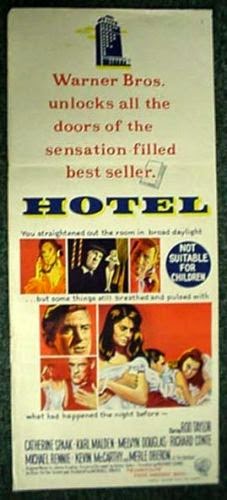
Austrailian daybill posters:
Austrian/German poster, prorgrams, and lobby cards:
A Spanish poster:
A Cuban poster:
A Mexican lobby card:
A program from Iceland:
Japanese magazine clippings:
Screen Stories ran a feature about the film in April 1967:


+(2).jpg)
.jpg)
.jpg)
.jpg)
.jpg)
.jpg)
.jpg)
.jpg)
.jpg)
.jpg)
.jpg)
.jpg)
.jpg)
.jpg)
.jpg)
.jpg)
.jpg)
.jpg)
.jpg)
.jpg)
.jpg)
.jpg)
.jpg)
.jpg)
.jpg)
.jpg)


.jpg)
.jpg)
.jpg)
.jpg)
.jpg)
.jpg)
.jpg)
.jpg)
.jpg)
.jpg)
.jpg)
.jpg)
.jpg)
.jpg)
.jpg)
.jpg)
.jpg)
.jpg)
.jpg)
.jpg)
.jpg)
.jpg)
.jpg)
.jpg)
.jpg)
.jpg)
.jpg)
.jpg)
.jpg)
.jpg)
.jpg)
.jpg)
.jpg)




.JPG)
.JPG)
.JPG)
.JPG)